History

Indians first settled the area ten thousand years ago, the Timucuan being the most recent tribe. They valued the high, dry land, the nearby fording area and ample supplies of fish, shellfish, wild meat, and fruit. Settlers began to make their way up the River and inland from the coast after the Civil War and during the 1880’s. Welaka was incorporated in 1887. Its economy centered on the mineral springs, farming, fruit and lumber. Tourists from Europe, New England and the Mid-Atlantic States arrived in Jacksonville by steamship and rode paddle wheelers upriver to Palatka and beyond. From the decks, they viewed some of the best that Mother Nature had to offer - the banks of the St. John's and the Oklawaha, Salt Springs, Silver Glen Springs, Dunn’s Creek, Crescent Lake, Silver Springs and Lake George. The skies were alive with water birds, the water with reptiles, crabs and fish, and the land with deer, bear and panther.

The railroads concentrated on the coastlines and the new resort hotels. Florida’s sun and beaches became the main tourist call. Consequently, through two world wars and a depression, life on the St. John’s did not change much, overlooked for most of a century by Florida’s development.


Circa, 1950

                   satsuma
                               Satsuma on the St. Johns River- circa 1880-97
 
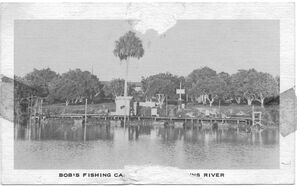
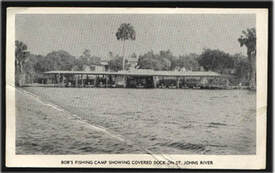
After World War II, Americans wanted to relax and enjoy life’s pleasures again. In 1946, Bob Allender began Bob’s Camp in Welaka Groves, a citrus grove on the east bank of the River about two miles north of Welaka. (The Allenders remained in the Welaka area right up to the end. Bob passed away at age 97 in 2006, shortly after the passing of his wife). The camp started as a single wood frame cabin (#3). Bob eventually converted the citrus dock, added three more cabins and sites for camping. The fishing was great. In 1972, Allen Norton acquired the camp and it became Norton’s Place. Bob moved across the street into a single-wide and Allen added a couple of mobile homes. In the mid-80’s, James Harmon, a quiet ex-Navy man who loved to fish, garden and keep to himself, moved into Bob’s old mobile home and became the caretaker and fishing expert.

In July of 1998, Jim and Terry Stege purchased Norton’s Place and renamed it Stegbone’s, one of Jim's college nicknames. (Sadly, James Harmon passed away one week prior.) A good deal of cleaning, repair and renovation occurred. Norton's double-wide moved across the road. From 2000-2004, the camp was managed by Mike Upton, an ex-Navy man, who made every guest feel like they had come home. He was special. Our present manager/caretaker, Stan  Plaisted, has lived in the area for 30 years and knows the river. He occupies the double-wide across the street and keeps track of everything. He is assisted by Gail Jones, who handles check-in/check-out and reservations.

Most of "what was" has not changed. The St. Johns River is one of the Great Heritage Rivers of America. The fishing is good and getting better. But it is not just the fishing. Life becomes simple and clear as you approach Stegbone’s. Any stress begins to float away when you cross the River in Palatka and again over Dunn’s Creek. Turn towards Georgetown and go over the railroad tracks in Satsuma, where the train no longer stops. From another world, Amtrak and CSX to Miami and New York.

After a couple of miles of pastoral ranch land with cattle grazing in huge pastures, drive down Fish Camp Road and return to what is right with life: honest pleasures, shared with friends and family, in a peaceful and rich, natural environment. We await your next visit to the real Florida.

--Stan, Gail, Terry and Jim


Jim & Terry Stege Terry Jim Stan Entrance International
Sadie
Izzie Lu Sadie

Stegbone's Fish Camp
144 N. Fish Camp Road
Satsuma, FL  32189
386-467-2464
E-Mail Stegbones
 
Home Gallery/Links Rates History Information Accommodations